Made in Woolwich: Bernardine Evaristo at the Sheldonian, 6 May 2026
Ciaran Duncan and Olivia Fagan-Weston
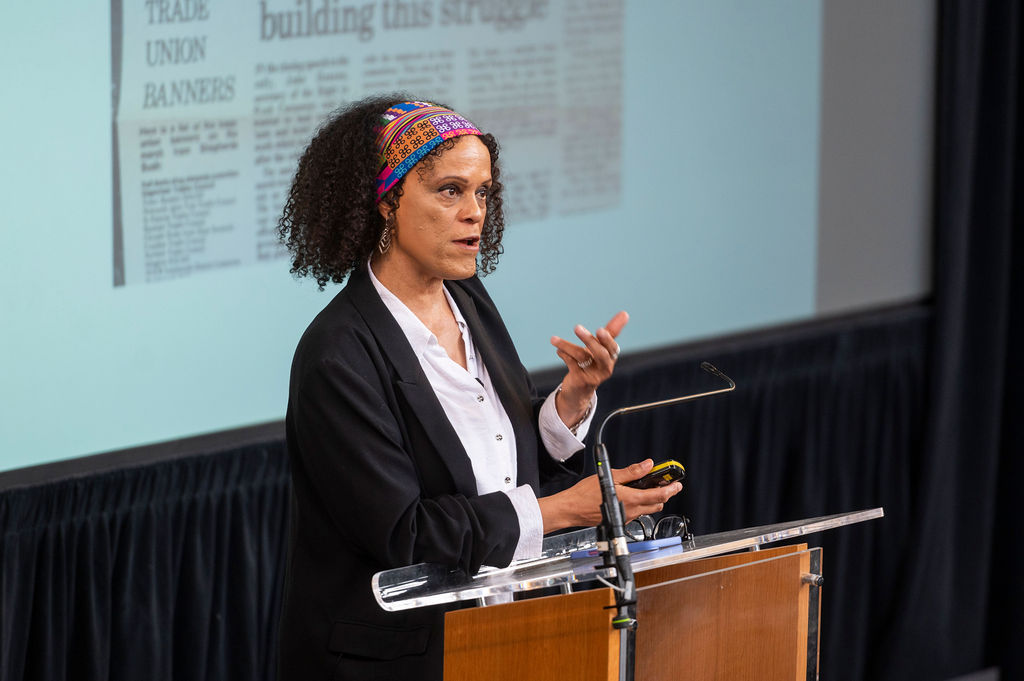
Bernardine Evaristo, Oxford’s News International Professor 2026, gave a lecture entitled ‘Made in Woolwich’ at the Sheldonian Theatre on 6 May 2026. Two Oxford postgraduate students, Ciaran Duncan and Olivia Fagan-Weston, report on their experience of the talk.
Ciaran
In her talk “Made in Woolwich,” Bernardine Evaristo demonstrated once again her ongoing belief in a collective feminism, characterised by collaboration and mutual championing – one that is never just centred on the individual success of a single trailblazer. Her talk wove between family history, local history and social analysis to offer a deep insight into how this maker of art was herself built up by, amongst other things, “a family of women who make things.”
A feature that stood out for me was the fact that, as a teller of family history, Evaristo is deeply, generously empathetic, all the while never sugar-coating or ignoring damage or harmful flaws. A whole section of Evaristo’s mother’s family cut off contact with her for marrying a black man. Perhaps surprisingly, Evaristo says that she herself can see where that half of the family was coming from at the time. In her words, whilst living in 1950s Britain, they may have seen little alternative to racist mythologies. Similarly, whilst dwelling on the fact that her father could be “a dictator in the household,” generating fear in other family members, Evaristo nonetheless pays full attention to his achievements working as a Labour councillor for the borough of Greenwich, on top of holding down his job as a welder.
Evaristo’s talk was peppered with family photographs and other visual material which deepened the intimacy of the insights she offered. She shared a feminist poem her younger self had written for the school magazine of her girls’ grammar school in Eltham, entitled “Militant Ladies,” drawing applause and cheers in the room. The writer’s craft may evolve, but some instincts remain intact and central.
The plural title of “Militant Ladies” speaks to Evaristo’s consistent concern with feminist practice. Indeed, I was struck – the same as during her last talk at the Sheldonian in June 2023 – by just how much emotional and material effort Evaristo invests in supporting other women. Her co-founding of Theatre of Black Women in 1982 (with Patricia Hilaire and Paulette Randall) was a significant moment in the history of British theatre. Just last year – directly reinvesting the £100,000 she herself received in 2025 as winner of the Women’s Prize outstanding contribution award – Evaristo founded and funded a Royal Society of Literature Pioneer prize for outstanding British female writers aged over 60. The inaugural award went to (now late) Maureen Duffy. Evaristo’s obvious joy in sharing a picture of Duffy being recognised was infectious, as was her commitment to finding ways to live a life in community rather than competition with other people, not least with other “women who make things.”
Olivia
In her return to Oxford’s Sheldonian Theatre, Evaristo provided a compelling exploration of her personal and artistic development. Building on her 2021 memoir, Manifesto: On Never Giving Up, she did not merely recount her life’s chronology; she traced a genealogy of resilience. Through her characteristic warmth, wit, and candour, she illustrated how a complex family history and an upbringing shaped by social adversity formed the foundation for her agency, and creative vision.
Central to Evaristo’s address was the idea that inner strength is an inherited trait, passed down through generations. To contextualise her journey to the 2019 Booker Prize, Evaristo examined the broad, international scope of her ancestry and traced her lineage across continents and generations: a Nigerian father, a white English-Catholic mother, Yoruba and Irish ancestors, and a German immigrant great-grandfather, Lewis, whose Woolwich bakery was destroyed during wartime anti-German sentiment. Rather than perceiving this diverse heritage as a source of fragmentation, Evaristo presented her migrant ancestry as a testament to fortitude. She reflected on the courage of ancestors who traversed the globe without the digital safety nets of the modern era, noting that her forebears were true survivors who travelled out of necessity, leaving behind everything they knew to build new lives. In her view, subsequent generations inherit the strength required to survive such journeys, grounding modern identity in ancestral perseverance.
This inherited fortitude is equally rooted in the material craft of the women in her family. Describing her maternal line as a lineage of women who made things (including her mother and Irish ancestors, who stitched nearly everything they wore), Evaristo linked their craft to her own literary world-building. Yet history is as much defined by silence as by tangible creation. Recalling the discovery of a thumbprint signature on a property deed, Evaristo spoke of how she realised her paternal grandmother was illiterate and reflected on the opportunities denied to previous generations. Pausing over a photograph of her grandmother late in life, Evaristo said how profoundly she was affected by the weight of unrecorded female experiences. At the same time, these ancestral struggles helped her shape an empathetic, layered approach to her own character development.
Although her heritage provided an important foundation, Evaristo’s childhood in Woolwich during the 1960s and 1970s was also instrumental in shaping her artistic voice. Growing up as one of eight children in a distinctive, dilapidated house described as a ‘scar on the street’ in a predominantly white, working-class area, Evaristo experienced life on the margins. Yet her strength lay in her capacity to transform these challenges into sources of personal and political empowerment. She recalled her father, who, while enforcing strict patriarchal authority at home, was also a committed advocate for political reform and actively opposed systemic racism during his local council campaign. With characteristic humour, Evaristo remarked on her father’s intensity, suggesting it is unsurprising that she became a feminist.
Rather than hindering her, the strict environment of Evaristo’s childhood equipped her for artistic defiance. The strict Catholic discipline of her early education – and the poetic cadence of the Latin Mass – were transformed from a system of constraint into an early training ground for her literary ear, tuning her sensitivity to language from the age of five. When conventional paths proved unwelcoming, Evaristo as a twelve-year-old channelled her emerging feminist consciousness into alternative drama spaces. Recognising that traditional drama schools would likely pigeonhole or restrict Black actors, she sought out radical theatre communities alongside other self-identified outsiders. This awareness led her to cofound a theatre company in the early 1980s, creating the very platforms that mainstream culture had previously denied her.
Evaristo’s talk ultimately demonstrated that her Booker Prize victory at sixty was not an overnight anomaly but the result of a sustained, determined commitment to creative freedom. By revealing the deep roots of her journey, rather focussing merely on the outcome, she provided the Sheldonian audience a compelling model of agency. Through reclaiming her working-class background, honouring the uneducated women in her family, and transforming childhood adversity into artistic conviction, Evaristo demonstrated that hardship does not have to define one’s life. By celebrating the survivors and creators in her lineage, she transformed historical marginalisation into a call for creative self-determination.
Cite this: Duncan, C. and Fagan-Weston, O. “Bernardine Evaristo: ‘Made in Woolwich’ (2026).” Postcolonial Writers Make Worlds, 2026, https://writersmakeworlds.com/evaristo-made-in-woolwich. Accessed 3 October 2026.